

Why execution matters the most?
Execution is the key difference between failure and success. You may have seen successful people or peers progressing in life, and thinking that they probably have better luck. Not going to lie, sometimes I do feel this way as well. We may feel like losers thinking about it, but, hey, no judgment, after all, we are just human!
Let’s just be logical and go to the root of failure. You would have realised that luck is actually a very tiny part of it and execution is everything in it.
John Doerr once said, “Ideas are easy. Execution is everything.”
Most of us have big dreams, from starting a side hustle to learning something new. But while ideas can come easily, results often don’t. Let’s be honest: We read, plan, and talk about doing things, but often, we do not really follow through.
In today’s AI and social media age, information is everywhere and knowledge is free. Good execution, however, is still super rare, and that’s why execution matters more than ever.
The people who succeed today aren’t those who know the most; they’re the ones who act the most consistently.
Why Execution Matters – What It Really Means
We often misunderstand execution and mistake it for busyness or constantly doing something. True execution or good execution is about working with clarity and purpose. That is knowing the direction, the purpose, what matters, and then focusing on that.
It’s doing the right things, in the right order of priority, at the right time.
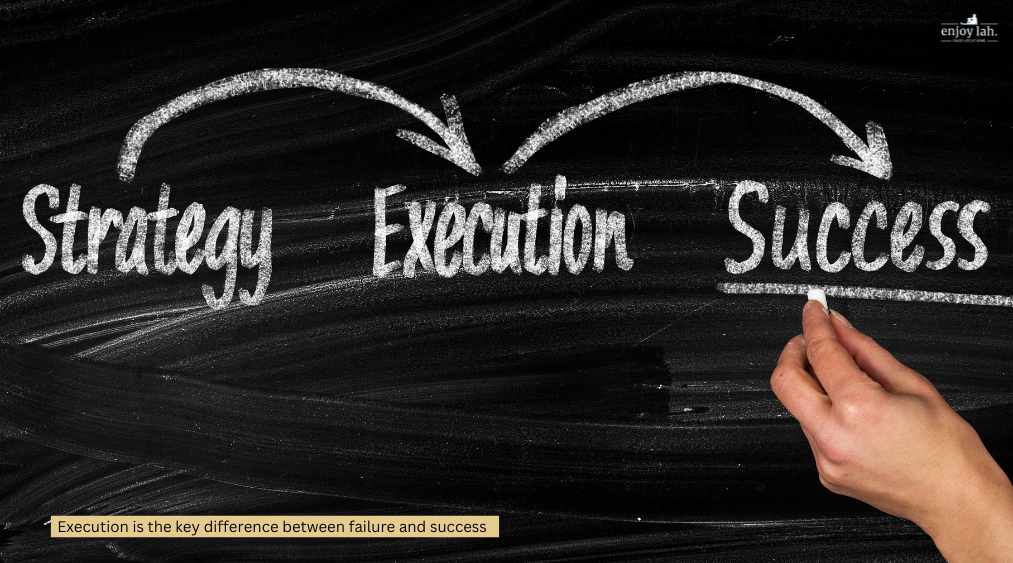
We have seen many examples in everyday life, from individual growth to businesses. For instance, two small businesses may start with similar ideas and compete in the same market, yet one grows faster. The difference isn’t just about talent or funding; it’s really about discipline in execution and the execution plan.
Thomas Edison once said, “Vision without execution is hallucination.”
This quote really hits home because it reminds us that why execution matters, not just having the right talent; it’s about turning ideas into reality.
Why Execution Defines Success (Not Ideas)
Naturally, many people may think that having the best idea matters a lot. It does matter, but it does not matter that much in the final outcome of success. Ideas can be everywhere, but finishers are rare.
We often overvalue ideas, thinking creativity alone will carry us through. But let me just share the cold, hard truth: poor execution quietly kills more dreams than bad ideas ever will. Our competitive edge lies in our ability to execute it according to the plan. Of course, the plan must also be right.
I always have this saying: how do you even judge that you have a bad idea when you did not execute it fully and properly to reach the finishing line?
Consider this:
- A startup with a modest idea but consistent delivery outlasts flashier competitors.
- A Gen X professional who learns and applies AI tools daily will grow faster than one who just keeps reading about them.
Peter Drucker summed it up perfectly, “Strategy is a commodity; execution is an art.”
That’s why execution matters in every area of life. It builds credibility and momentum, which are two things that no idea can create on its own.
Why Execution Fails: The Common Traps
If you understand why execution matters, and want to start with good intentions, your execution intent may still collapse because of these common traps.
Here’s what typically derails progress, and how to get back on track.
a) Procrastination
This is one big problem. Somehow, as we age, we tend to procrastinate a lot. I myself experience it, and I also observed that in my age group of peers. Many of us often like to wait for motivation, as if action should feel inspired. But motivation fades quickly; systems last longer.

👉 Try this: Push for a quick start. We can try the 2-minute rule: start any task for two minutes. Often, the hardest part is beginning. Once you start, momentum takes over.
b) Shiny New Toys
My biggest challenge. In the AI boom, we’re surrounded by new tools, apps, and trends. The temptation to test everything can scatter our focus.
👉 Tip: Push for more focus. Don’t switch tools or ideas until the current one has proven results. Because mastery will always beat novelty, and that’s a big part of why execution matters.
c) Poor Clarity = Poor Execution
You can’t execute well if you’re unsure what outcome looks like. Clarity removes friction and guides effort. Leverage AI to provide clarity and insight regularly
👉 Tip: Use AI like your assistant regularly. Try to prompt regularly on the existing idea or project you are working. For instance, I like to ask different questions about my current ideas to better understand on execution plan, clarity, and possible new insights to strengthen my execution.
d) Reactive Decision-Making
Rushing decisions might feel productive, but it usually means rework later.
👉 Pause before reacting. Adopt a “cooling window period” to make a decision. This helps to calm any emotion in decision-making so that we will always decide based on rational reasons rather than emotional ones.
Why Execution Matters – Mastering the Know-How
Good execution doesn’t happen by luck; it is actually by design. It’s really about structuring your effort so that we can see our progress, stay visible and rewarding.
Most people tend to give up not because the goal is too hard, but because they can’t really see movement. Hence, small wins matter. They can keep us motivated enough to stay focused, keep us on track, and push through when results seem far away.
Here’s how to make execution work in real life:
- Start small, scale steadily. Be pragmatic, start small, and scale progressively. Big goals can be overwhelming. We humans always need momentum, and by starting small with micro-actions and achieving micro-completions, the momentum will come.
- Plan for small wins. Define what progress looks like in bite-sized terms: finishing a page, closing one sale, learning one AI feature. These quick wins keep energy high and let you “see” progress. Over time, they compound into lasting progress.
- Use structured systems. Use a tracker to help you stay visible. Whether it’s Notion, Google Sheets, or a physical notebook, tracking actions creates accountability. When you can see what’s done, you’re less likely to drift.
- Build feedback loops. Practice self-cadence. Schedule a short weekly reflection: what worked, what failed, what to tweak. Small adjustments help prevent big mistakes.
- Leverage AI for precision. Your AI is your best advisor now. Use AI to draft plans, generate checklists, or simulate different outcomes before acting. Treat it as your “clarity partner”, it helps you see what’s next and avoid unnecessary detours.
In a nutshell, execution isn’t about doing more; it’s about doing better, one small, steady win at a time.
As Walt Disney once said, “The way to get started is to quit talking and begin doing.”
From Ideas to Impact – How AI Powers Better Execution
It’s important to reiterate that AI is here. Your AI is your best companion, your best colleague, or your best advisor. Though it can’t replace human motivation and drive, it can help you make execution smoother and faster.
Here’s what I normally use AI for and what it may also benefit you.
- AI enhances clarity: It translates big goals and breaks them down into clearer next steps.
- AI removes friction: It automates routine work, from scheduling to writing.
- AI enables self-cadence: It summarises our progress and highlights gaps.
Here are tools that I use daily and it make a real difference:
- ChatGPT – My main AI advisor, which helps break goals into actions or refine plans.
- Gemini AI – I love Gemini lately, it’s really a good brainstorming partner on mobile
- Deepseek AI – My brainstorming partner and also the second advisory to ChatGPT
- Perplexity AI – I always go back to perplexity to fact-check for statistics and trends.
- Canva and Canva AI – I turn ideas into presentations, visual storytelling
- Notion AI – I don’t really use it, but it’s a well-known ,useful productivity tracker.
I think generally most Gen X professionals are quietly using AI this way as a multiplier for focus and efficiency. And that’s another reason why execution matters, because now, AI levels the playing field, and gives everyone access to precision once reserved for top-performing teams.
The Mindset Shift Behind Why Execution Matters
Execution isn’t about speed; it’s about doing things right, consistently, and at the right time. We must not feel pumped and doing things we like, and dragging our feet when it comes to the things we dislike or are uninterested in. This is not good execution.
Hence, we need a mindset shift here.
In a world obsessed with fast results, the real edge lies in consistency. Progress doesn’t come from intensity once in a while, but from discipline every day.
We will bound to make mistakes, and it’s also important not to see them as proof of failure. Instead, we should see them as an opportunity to calibrate, adjust, and move on.
Robert Collier once said, “Success is the sum of small efforts, repeated day in and day out.”
That’s the spirit of execution, steady, patient, and practical.
Final Thought – Why Execution Matters
Ideas will always inspire us, but it’s execution that transforms us.
AI has knowledge democratized, leveled the playing field, and made it readily accessible. But discipline, follow-through, and persistence remain the best human values.
The people who will win tomorrow aren’t the ones with the best ideas or the best luck, but those who finish what they start. With AI as your clarity partner, there’s never been a better time to act.
So, stop waiting for perfect plans. Start small. Start today. Because that’s why execution matters, and it’s the only way ideas become reality.
FAQ – From ideas to Impact – Mastering Execution
Q1: Why is execution more important than ideas?
Execution turns ideas into proof. Without consistent action, even brilliant ideas stay hypothetical. Ideas inspire you but it’s execution that build credibility.
Q2: How can AI help improve my execution?
AI helps break down big goals into insights, steps, automates small tasks, and provides accountability reminders. The best part? They do it in speed to provide knowledge.
Q3: What’s the biggest reason execution fails?
Lack of clarity, procrastination, and distraction from “shiny new tools.” Focus matters more than variety.
Q4: How do I stay consistent?
Build a system of self-cadence. Use trackers for checklists, reflections, and AI reminders. Make discipline part of your routine, not your mood.
Q5: Is failure always due to poor execution?
Not always. Failure offers insight and learning. The more you act, the more data you get to improve your next attempt. Which is why it’s common to see growth company dedicated to incorporate lesson learning as part of their growth program.