Why do we always fail?
The reasons we felt we “keep failing” can be down to some core reasoning and principles.
When we start asking ourselves this question, it’s probably the time when we could feel we have hit the bottom. Failure can feel personal because we often see it as the end of effort. Many of us were taught in the old school that success is a straight line. By working hard, doing things right, we will get there. Yet, in reality, even smart, capable people fail repeatedly.
Hence, if you drop by this article, just want to say, do not be disheartened! This is part of life!
In fact, the truth is simpler and less painful: we don’t fail because we’re not good enough; we fail because of how we approach progress.
Let me share with you some core reasoning and principles on the feeling of why we always fail, and how we actually could reframe failure into small, steady steps that lead to real growth.
Why We Keep Failing? – Execution Gap Being the Biggest Culprit!
Here’s the interesting fact. Failure rarely comes from lack of talent or intelligence. We generally know what to do. The biggest problem is, we often struggle with doing it consistently.

This is, in fact, what I like to term the execution gap where the gap between intention and action. We have plans, ideas, and motivation, but somewhere between thought and follow-through, we fail to keep up with the same energy consistently.
Then why do we execute poorly if the heart is willing? Naturally, we could think of a lack of discipline. But there are also other factors.
Major factors of poor execution:
- Overthinking – Detailing is important, but over-analyzing every detail can lead to procrastination! Sometimes, we just need a “Just do it!” attitude.
- Distraction – As humans, it’s natural that we will be distracted. It does not help if one is always chasing shiny new toys! It’s really important to keep our focus.
- Overplanning – Being ambitious is important for growth. But too much of it leads to overplanning, and we could end up facing a hard time completing the ambitious plan.
- Discipline – Without doubt, discipline is critically key in execution. And we also need our self-cadence to constantly check our own progress.
The ability to stay true to our plan will help improve our execution.
Why We Always Fail? – Reactive Trap the Partner in Crime!

Then there’s the reactive trap. We respond to emotions, urgency, or fear instead of strategy. When results don’t come fast, we pivot too quickly, switching goals before the first one matures. This can lead to opportunity cost and ultimately the feeling of failure!
I know it’s harder to say, let’s avoid the reactive trap. In real life, it’s not as easy as it i,s especially when comes to our own emotions.
Major factors that help set up the reactive trap:
- FOMO – Fear of missing out is the worst. Because of FOMO, the decision-making in us could become absolutely chaotic and rushed. What we can do is to accept that we cannot have all the lunches in the world and leave some on the table.
- Chasing Shiny New Toys – When we stumble upon another great idea, we naturally feel the adrenaline pumped and rushed. We need to give ourselves a “cooling window” period. It could be, let’s revisit the idea again after a couple of days.
- Frustration – No doubt, when we do not see results, frustration builds up. We will start to dwell on “why this happens”, instead of rationally looking at the stalling progress path. Sometimes, this could be the point where we decided to give up.
Over time, poor execution and emotional reactions feed each other, creating a loop of short bursts followed by disappointment. That’s the typical hidden rhythm behind why we always fail.
The Definition of Success Actually Sets Us Up to Fail
Another reason we feel “why we always fail” is how we define success. I think many of us tend to treat it as a single big win like getting a promotion, having a business breakthrough, or hitting a financial milestone.
But success doesn’t arrive in one dramatic moment; it grows quietly, through repetition and also through the building up of successful small wins.
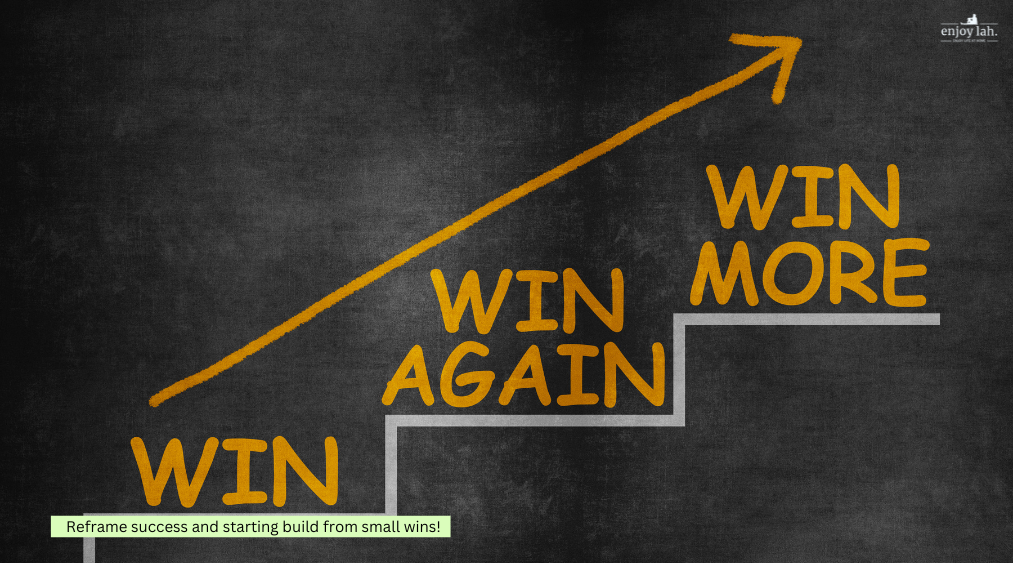
For instance, for a promotion, it probably takes several impressive performance wins for the staff to be promoted. For the business breakthrough, the business probably went through several losing bids and smaller winning bids before landing a big breakthrough. Similarly, to hit a financial milestone, the financial wins need to compound over time to achieve that milestone.
When success feels distant, energy will sap, and motivation dies early.
It’s like saving money; you don’t notice the growth each day, but discipline compounds over time into stability.
To stop asking why we always fail, we need to shift focus: success isn’t a finish line; it’s progress made visible.
The habit of showing up, even imperfectly, counts more than one grand victory.
Recognizing The Patterns – Why We Always Fail
There are systemic patterns to failure, and here is the summary of familiar ones that many of us fall into:
- Overthinking instead of doing – analyzing every detail until nothing moves.
- Overplanning – Doing it all can lead to doing nothing at all.
- Poor execution – starting strong but losing focus halfway.
- Emotional decision-making – reacting in the heat of the moment.
- Chasing shiny new toys – jumping to trends before mastering basics.
- Ignoring small wins – overlooking progress because it feels too minor.
These patterns make failure feel constant, even when we’re improving in small ways. Recognizing them is the first step to breaking free.
How do We Break the Cycle and Reframe Success?
The key is to build from the small wins up. To turn failure into growth, start small, and it can also be very small.
If you want to stop why we always fail frustration, a few habits help reset the pattern:
- Plan well, set short-term goals for small wins and long-term goals to hit the milestone
- Embrace the Power of Pause, or what I call it, the “cooling window” period, to allow oneself to calm down the emotion before any decision
- Learn a digital skill weekly or monthly, learning new things gives you a small win!
- Create digital content regularly to give a boost to your creative thinking
- Make it a point to go out, “touch some grass!” practicing the power of pause
- Read a book monthly, to enrich our thoughts, and that is also a small win!
Each micro-goal provides evidence that you can move forward and progress is made. When small actions stack up, momentum builds naturally.
Think of success as a ladder built from small wins, not one giant leap. This mindset shift helps stop the cycle of asking why we always fail, because you’ll start seeing wins every step of the way.
Final Thoughts – Why We Always Fail
Failure is data, not a verdict. It tells us what needs refining, not who we are. Each misstep tells us something, whether our pace is off or our focus is misplaced.
We don’t fail because success is far away. We fail because we forget that progress comes in small, uneven steps. When we learn to execute calmly, think before reacting, and celebrate little wins, success stops feeling like luck; it starts looking like a system that we build.
So, the next time you ask why we always fail, remember: failure is just feedback. Growth begins when you listen.